The execution journal for self-directed traders

Build a trading process
you can rely on.

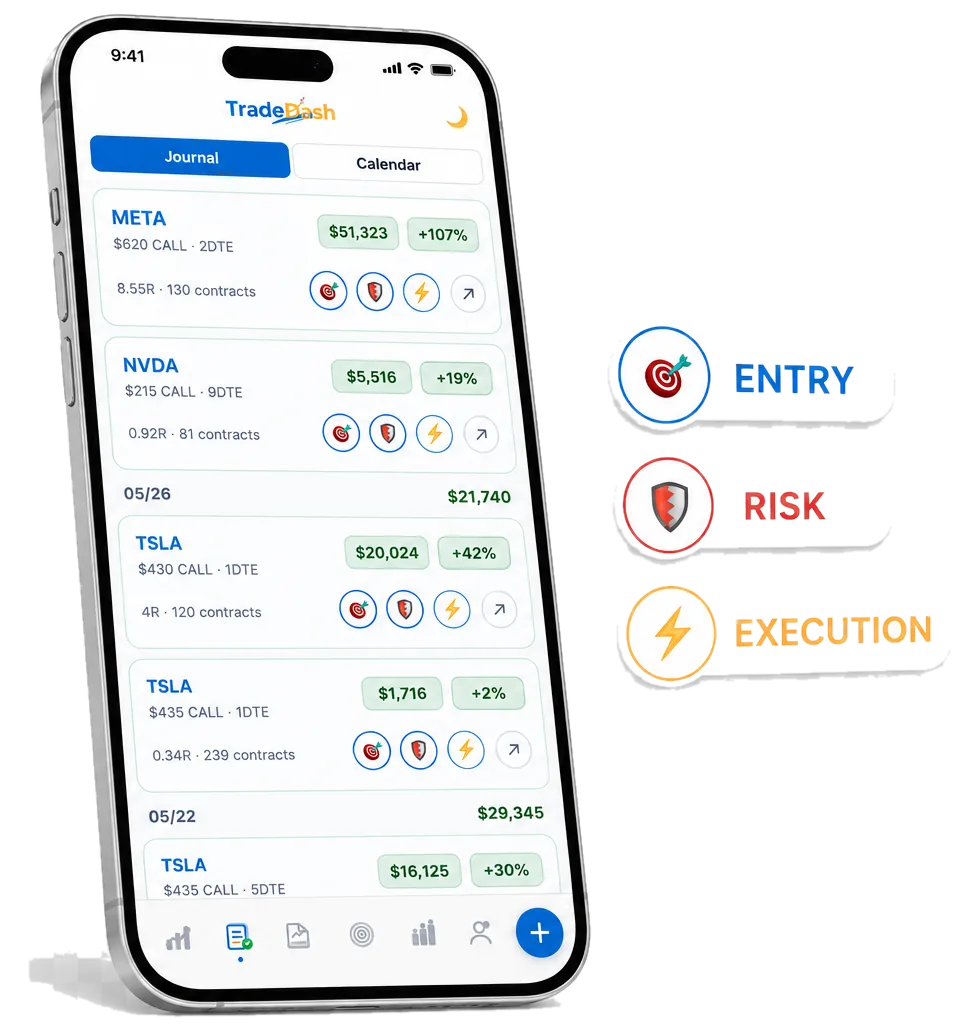
Stop letting your last winner or loser decide whether you traded well. TradeDash grades the three behaviors you actually control — entry, risk, and exit — so you can see which habits are building your consistency, and which are quietly breaking it.

Already have an account? Log in
TradeDash on three phone screens: the Journal listing graded trades, Insights flagging a declining win rate, and the Playbook of tagged chart setups
📄 CSV import or manual entry 🔒 Never connects to your broker Cancel anytime 🛡️ 30-day money-back guarantee
The consistency problem

Most traders approach their consistency problem completely wrong.

You already know what to do. You’ve read the books, watched the videos, sat through the courses. The gap was never knowledge.

The answer isn’t another strategy. It’s clinical execution, repeated over and over again — and the only way to repeat something reliably is to measure it.

The three behaviors that matter

Entry. Risk. Exit.

Not the market. Not the outcome. Just the decisions you could control before, during, and after the trade.

🎯 01
Entry

Did you enter where your plan said you would?

🛡️ 02
Risk

Did you size the trade according to your risk rules?

03
Exit

Did you exit at your plan’s target or stop?

Execution = Entry + Risk + Exit

Execution isn’t one rule. It’s what you get when all three are right.

What you actually get

Five questions your P&L can’t answer.

A complete system for reviewing execution, finding patterns, and turning your rules into repeatable behavior.

01

Did I actually follow my plan?

Grade every trade on the three decisions you control — Entry, Risk, and Exit — so a winning trade cannot hide a broken process.

The TradeDash journal listing trades with pass and fail grades
02

Is my short-term process becoming long-term consistency?

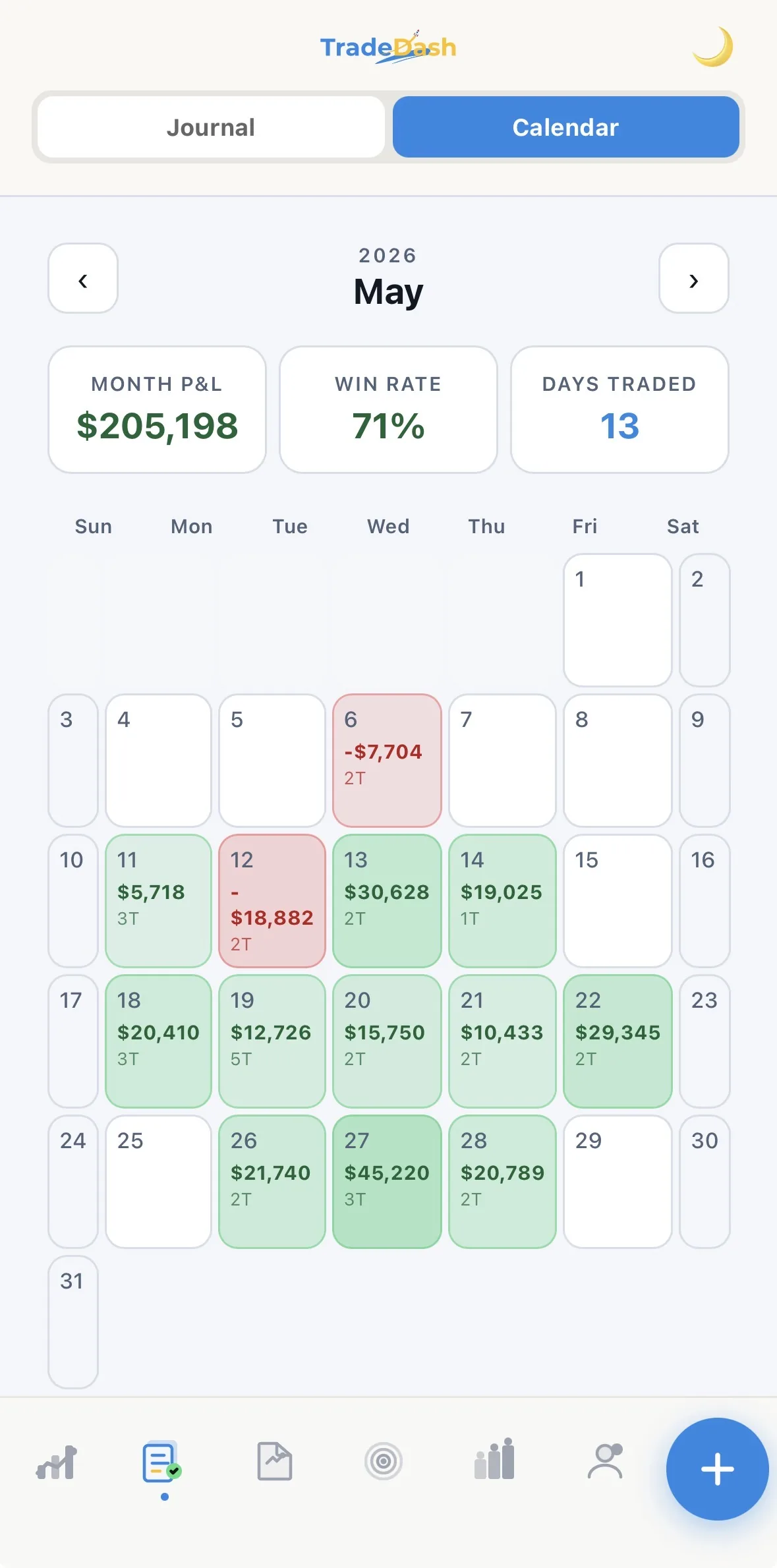
The calendar shows every trading day at a glance. Individual days are noise; the month is the signal.

The TradeDash calendar showing daily results across a month
03

Which patterns deserve a place in my playbook?

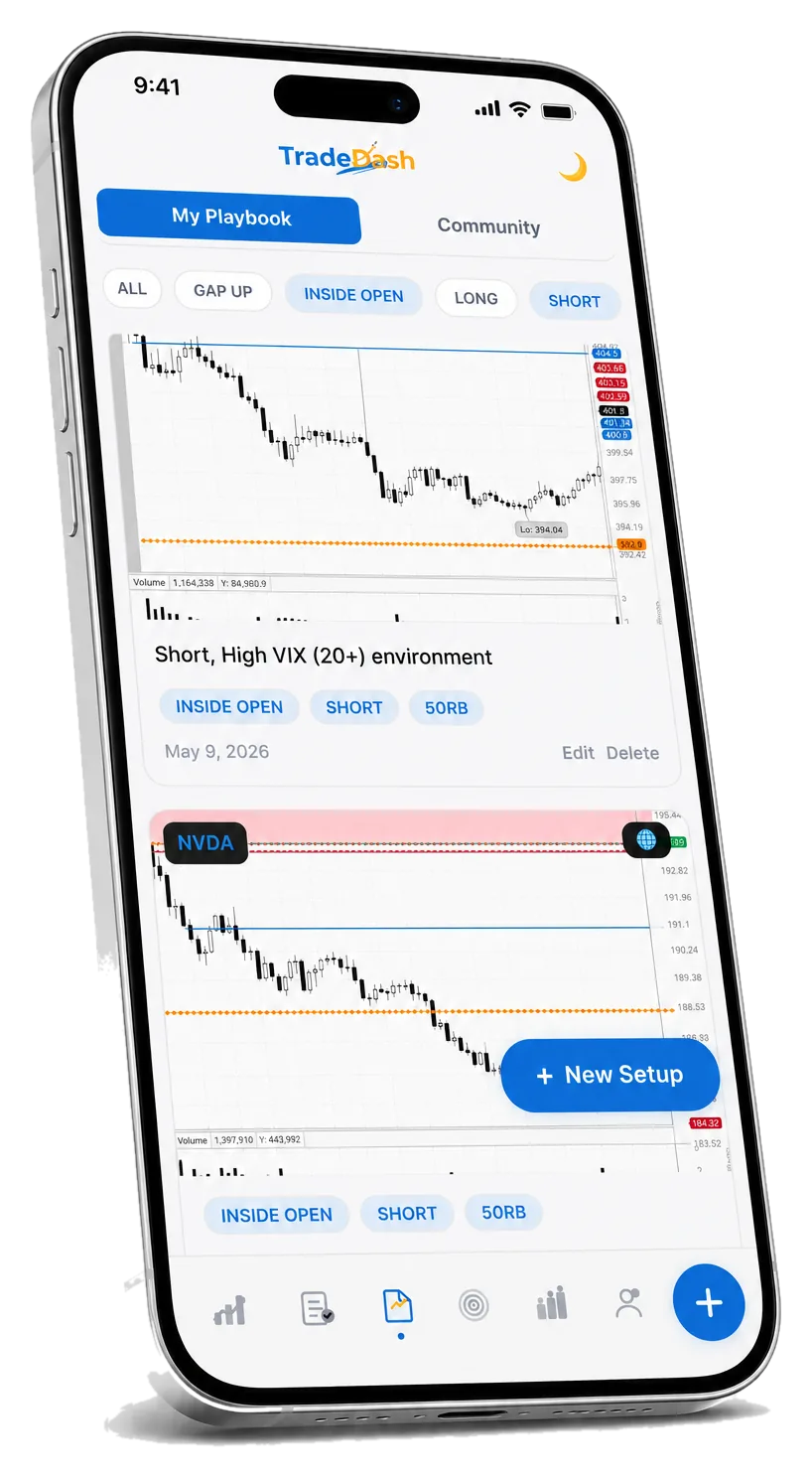
Tag every setup, upload the chart, filter by outcome. Over time the Playbook answers which behaviors — in your trading, not someone else’s — actually produce results.

The TradeDash playbook with tagged chart setups
04

Am I trending in the right direction?

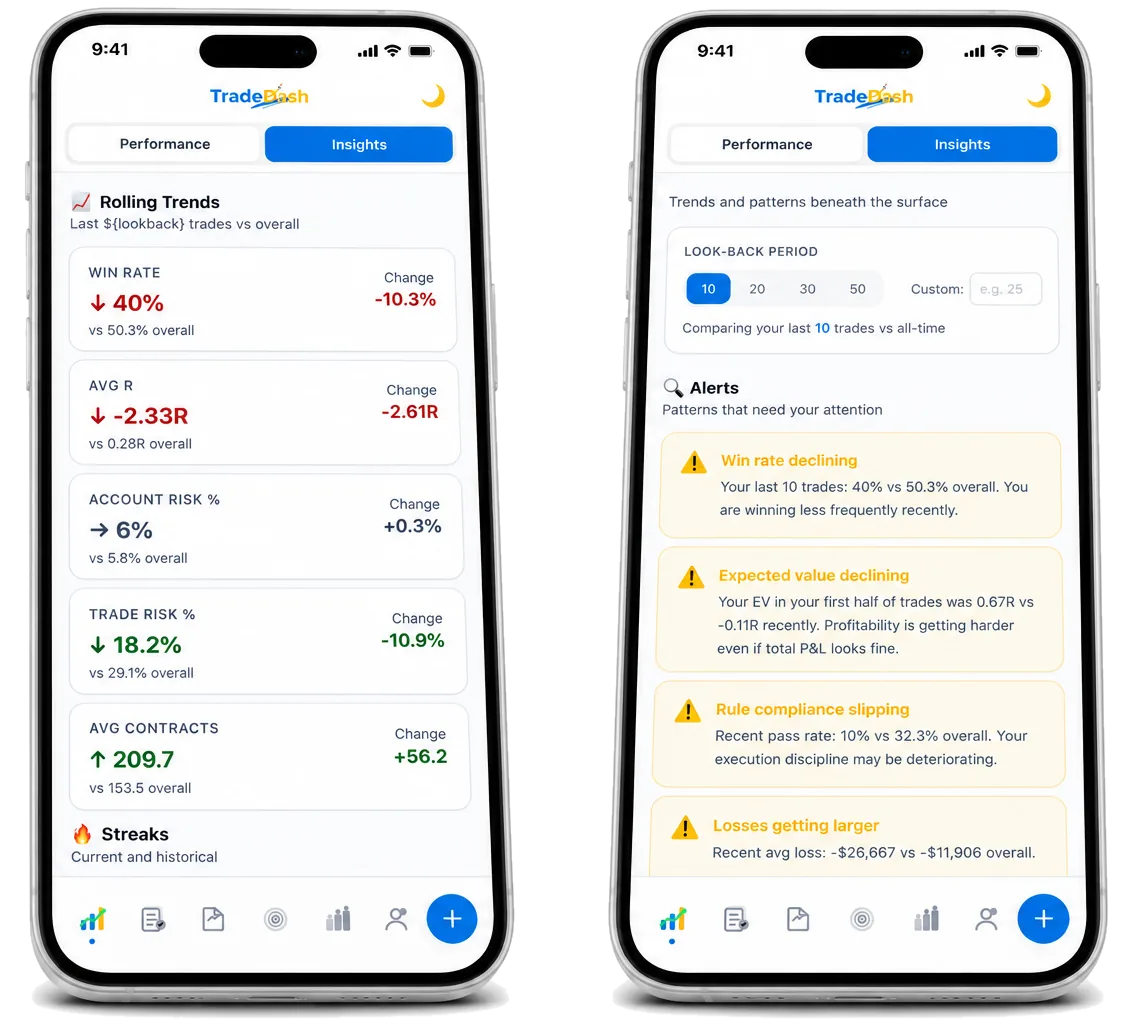
Rolling insights compare your last ten trades against your all-time record and flag the drift before it becomes a drawdown.

TradeDash insights flagging declining win rate and rule compliance
05

Is my process producing better results?

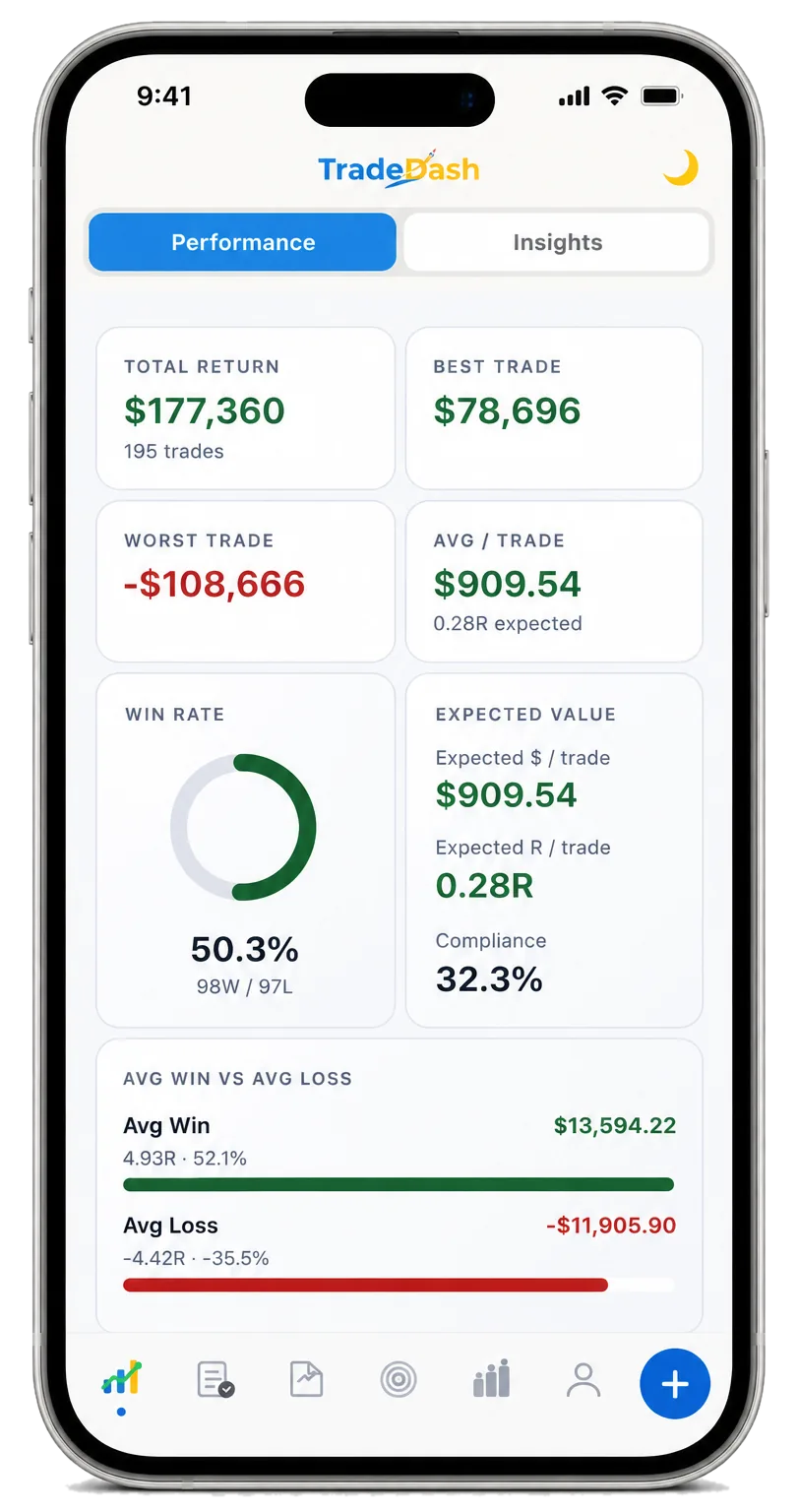
Expected value, compliance rate, performance by ticker and setup. The numbers that tell you whether the discipline is paying.

The TradeDash performance dashboard
What changes

Stop hoping for discipline. Start measuring it.

Without a system

  • Judge the trade by the P&L
  • Trust memory to spot the pattern
  • Hope discipline holds
  • Change strategy after a bad week
  • “Did I make money?”

With TradeDash

  • Judge the trade by the process
  • Track every trade against your rules
  • Measure discipline as a number
  • Build a playbook that compounds
  • “Did I follow my process?”
The Dash of 10

Ten trades is where the pattern shows up.

Review ten consecutive trades against Entry, Risk, and Exit and you have a Dash. For most traders that’s two to three weeks — and it’s the point where the habit starts running on its own.

Zero winning trades required. A losing trade executed correctly still counts. That’s the entire point.

From a spreadsheet to a system

I built this because I kept breaking my own rules.

TradeDash started as a Google Sheet I built to hold myself accountable. The sheet worked — but manual entry didn’t. I wanted broker imports, better analytics, a visual Playbook, and something I could use from my phone.

I still use it every day. Now I’m sharing it with other traders.

TradeDash
Founder of TradeDash
Pricing

Start free. Upgrade when it earns it.

A free account gets you started with a limited set of features. Everything below unlocks the full grading engine.

Free
Create a free account
No card needed →
FULL ACCESS

30-day money-back guarantee

Build your Dash of 10 and I’m confident you’ll see your execution improve. If you don’t — for any reason at all — email us inside 30 days for a full refund. No conditions, no questions. You don’t even have to finish the Dash.

Secure checkout via Stripe · Charges appear as STOCKONOMY on your statement

Questions

Questions traders ask before starting.

01What is TradeDash?

An execution journal. You log or import your trades, grade each one on Entry, Risk and Exit, and TradeDash tracks whether you’re actually following your own rules over time.

It doesn’t tell you what to trade. It tells you whether you traded the way you said you would.

02Is this another trading strategy?

No. TradeDash is strategy-agnostic. Bring whatever you already trade — options, equities, futures, any timeframe.

The system measures execution, not setups.

03How is this different from a spreadsheet?

Most journals record what happened. TradeDash evaluates whether you followed your process.

Instead of collecting thousands of rows you’ll never review, it grades Entry, Risk and Exit, tracks your Dash, builds your Playbook, and surfaces the habits worth repeating.

04Do my trades have to be winners?

No. A losing trade executed correctly is a pass. A winning trade that broke your rules is a fail.

That’s the entire point.

05What brokers can I import from?

TradeDash never connects to your brokerage account. You export a CSV of your trades and upload that file — no logins, no passwords, no read-only keys, no account linking.

  • TradeStation
  • Charles Schwab
  • thinkorswim®
  • tastytrade
  • Webull

You can also enter trades manually, so TradeDash works even if your broker isn’t listed — any broker that exports a CSV will do.

06What’s in the free account?

A limited set of features — enough to log trades and see how the grading works. The full grading engine, Dash streak, Playbook, Insights and leaderboard come with a paid plan.

No card is needed to start, and nothing converts automatically.

07What happens after the 30-day access ends?

Access simply ends. The one-time plan doesn’t renew and there’s nothing to cancel.

Your journal isn’t deleted — if you come back later, everything is still there.

08Can I cancel a subscription anytime?

Yes, in a few clicks from your account settings. No phone call, no form, no email required.

You keep access until the end of the period you’ve already paid for.

09Can I use TradeDash on my phone?

Yes. TradeDash works on desktop, tablet and mobile. Many traders review on a computer after the close and check in from their phone during the day.

10Is my trading data private?

Yes. TradeDash has no access to your brokerage account, because you never connect one. Your trades, notes and chart uploads are private to your account.

We don’t sell your data, publish your positions, or share your results.

Before you go back to the charts

Your next trade starts a pattern either way.

Start with a free account and grade one trade. That’s the whole habit in miniature.

Already have an account? Log in

Risk disclosure. TradeDash is a trade journaling and self-review tool. It is not a broker-dealer, investment adviser, or financial planner, and nothing in the product or on this site is financial, investment, tax, or legal advice, or a recommendation to buy or sell any security. Trading and investing carry substantial risk, including the risk of losing more than your initial investment. Options trading is not suitable for every investor. Past performance never guarantees future results. Any figures shown reflect real activity but are illustrative and are not representative of typical results. You are solely responsible for your own trading decisions.